Learning Outcomes
Students will be able to:
i. Define reversible and irreversible processes, highlighting their distinguishing characteristics.
ii. Explain the concept of entropy and its role in determining whether a process is reversible or irreversible.
iii. Identify examples of reversible and irreversible processes in various physical phenomena.
iv. Appreciate the implications of reversible and irreversible processes for energy conservation and efficiency.
Introduction
In the grand orchestra of nature, change is a constant, shaping the world around us. Processes, the transformations that occur in systems, can be either reversible or irreversible. Understanding this distinction is crucial for comprehending energy flow, efficiency, and the limitations of thermodynamic systems.
i. Reversible Processes: A Symphony of Perfect Reversal
Imagine a perfectly elastic ball bouncing up and down. As the ball rises, its gravitational potential energy increases, while its kinetic energy decreases. When it falls, the process reverses, and its kinetic energy increases as its potential energy decreases. This idealized scenario represents a reversible process, a process that can be perfectly reversed without any net change in the system or its surroundings.
ii. Irreversible Processes: The Symphony of Energy Dissipation
In contrast, irreversible processes involve some form of energy dissipation or degradation, making them impossible to perfectly reverse. For instance, when a hot object cools down, it transfers heat to its surroundings. This heat transfer cannot be completely reversed without the use of external energy or machinery.
iii. Entropy: The Measure of Disorder
Entropy, a fundamental concept in thermodynamics, measures the degree of disorder or randomness in a system. The entropy of a system tends to increase over time, as processes move towards a more disordered state. This increase in entropy is closely linked to the irreversibility of processes.
Examples of Reversible and Irreversible Processes
Reversible and irreversible processes are prevalent in various physical phenomena:
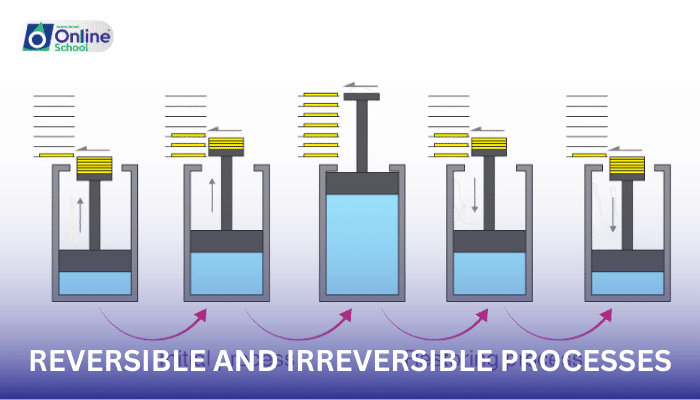
Reversible Processes: The expansion and contraction of an ideal gas in a closed system can be considered reversible if the process is slow and there is no friction or heat loss.
Irreversible Processes: The flow of heat from a hot object to a cold object, the mixing of different substances, and the expansion of a gas against friction are all examples of irreversible processes.
iv. Implications for Energy Conservation and Efficiency
The distinction between reversible and irreversible processes has profound implications for energy conservation and efficiency:
Reversible Processes: Reversible processes are ideal for energy conservation, as they involve no energy loss or dissipation. However, reversible processes are often difficult to achieve in real-world situations.
Irreversible Processes: Irreversible processes are associated with energy dissipation, leading to a reduction in the efficiency of energy transfer or conversion. Understanding these processes is crucial for designing more efficient systems and minimizing energy losses.
The concepts of reversible and irreversible processes provide a framework for understanding the limitations of energy conservation and efficiency. Reversible processes, while often idealized, serve as benchmarks for achieving maximum efficiency. Irreversible processes, the reality of our world, highlight the challenges of minimizing energy losses and optimizing energy utilization. As we continue to explore the universe, the distinction between reversible and irreversible processes remains a guiding principle, illuminating the path to new discoveries and advancements in our understanding of the symphony of change that governs our world.
